|
A lot of studying the piano is learning to copy, from our youngest years through at least until completing undergraduate education. Initially, this isn’t a bad thing. We need models to learn:
But there comes a time that we want to move away from copying. Until we do, we generally only function as accidental, or perhaps unintentional, pianists. We’ve done everything by chance, regurgitating what we’ve learned instead of processing and adding value to everything we’ve been taught. Sometimes when we think we’ve gone off on our own, we haven’t actually done so. I’ve argued that the act of performing is at least as important as the texts on which our performances are derived. I believe our ears are easily manipulated by what we hear and most of our performance decisions are not truly our own; see case studies in Beethoven and Liszt. And so I’d like to suggest embracing what I have decided to call 'intentional pianism'. What makes a great pianist stand out? Our favorite pianists have at once a pianistic voice that is all their own, that sounds completely familiar, and simultaneously keeps us thinking and guessing. They’ve studied all the rules but have commanded the authority to break them. They have a sort of intentionality to the way they play music. All this is not to suggest that intentional piano playing is limited to the great masters. Some of my absolute favorite musical memories are from pianists who are not famous to the general classical music population. Some of the most distinctive performances I’ve seen were by students who brought an energetic commitment rare among artists, others are from professional artists who have sought their own career path, whether to pursue unique repertoire or venues for their performances. Anyone can play with intentionality. Nor do I want to suggest that our educational system is failing students. I’ve benefited from studying with an incredible, diverse group of piano teachers, all of whom are brilliant, and largely fall into the category of a ‘traditional’ piano teacher. And there’s nothing wrong with role of traditional piano teacher, in fact, traditions are essential. But to step out as performers with a personal intentionality, we need to use traditions as a stepping stone, not an end in themselves. Our professors in lessons and classes only have so much time to help us reach the level of being a unique artist. My goal with this blog and other future endeavors is to supplement the great teaching that goes on in piano lessons and schools of music. I believe some of the keys to being intentional include:
With this blog, most of all, I hope to outline how one can become a truly independent, a truly intentional pianist. Over the course of this next year, I’m going to present 5 blog series along with several standalone posts. First will be Extraordinary Recordings, a series studying several of my personal favorite performances on record, focusing on what makes the performer so unique. This will be, in a sense, a series of 9 case studies on pianistic intentions. Simultaneously, I will report on my viewing of the Cliburn Piano Competition, my favorite performances as well as thoughts on the repertoire chosen, and nature of competitions in general. What better way to ruminate on the state of intentionality than by studying this competition of world-class, young talent? Later on, with the hope of inspiring some summer reading, I will release a series of posts on Influential Books. Some of these will be explicitly musical, but several will be from outside the musical world. In the fall, I will be ruminating on the Coexistence of Contemporary and Traditional Classical Music. This will be in preparation for a project that I’m very excited about, which I will announce later in the summer. Finally to end the year, I will discuss my views on Performance Practice, especially focusing on my work studying the amazing pianist Ervin Nyiregyhazi. I hope you’re as excited about this journey as I am. Please subscribe to my e-mail list to the right, as I would love to keep you apprised as each new series is rolled out, as well as my projects as a performer.
Here's a post especially for my students!
I'm preparing a BIG piece for performance in a few weeks at the Toledo Museum of Art, part of a marathon concert of 10 pianists playing Messiaen's Catalogue d'Oiseaux. I'm playing the 7th of 13 pieces: La Rousserolle Effarvatte. Here's a link to the event This is difficult music to listen to, especially if you've never listened to contemporary music! Even if you have, this piece jumps around a lot and it's hard to find a through-narrative. What should you listen for? Yet, I think this piece is truly beautiful. As a result, I decided to create a series of audio/video posts to aide in listening. Here's the first in the series where I discuss some general background to the composer and the piece (recorded with real live birds in the background!), and two specific bird calls that Messiaen uses: I go by "Dr. Jeff" with my young students. Though I don't derive any self-confidence from the title alone, I like using it: I am proud of the work I put in to earn the title, plus "Dr", being a little more formal than "Mr.", allows me to be more informal and go by "Jeff" instead of "Manchur". I like "Dr. Jeff" a lot more than "Mr. Manchur".
Perhaps I could use the title to defend their practice assignments: I'm "doctoring up" how you play the piano. A lot of my suggestions probably seem a little absurd. Isolating sections, blocking chords, playing differently than written. I'm not surprised if my students don't really 'get' what I'm after. Well, believe it or not, I do use these same techniques myself! I've begun to collect videos of myself practicing (some annotated with in-video text, some referencing other blog posts here), as well as visual reminders of analogies I often make in teaching (the baby learning to walk perfectly demonstrates how learning is a process and making mistakes can be good), and good practice tips from other authors. Please subscribe to my YouTube Channel, and this Playlist to get the latest videos as they're developed! 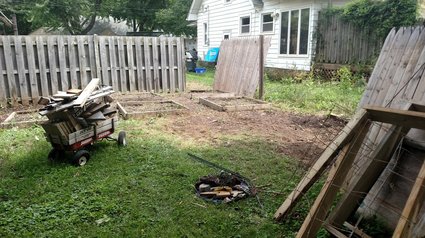 My wife and I bought a house almost a year ago, a home we absolutely love. It’s old, well maintained and full of character. We were ‘sold’ as soon as we saw it. One misgiving we had was the backyard-the garden area was very over grown with tall weeds, and piles of yard waste. So my Dad came out one weekend to help me clean it up. We forgot to take a ‘before’ picture, but here’s an ‘after’ picture of our beautification project: I share this image because I think it is decidedly NOT beautiful! Grass has been torn up, we collected piles of wood, tomato plant cages, the garden boxes were rotting and falling apart, we found out our fence was not as steady as we’d thought, and the “garden” is still weedy and needs some good working-through before it will grow our preferred vegetation properly. But it IS much more beautiful than it was. I think this is a great analogy for my general practicing philosophy. I’d bet many of my students don’t take to my practice suggestions easily, and I can see why. I often ask them to distort what is on the page. Whether it’s practicing in rhythms, blocking, changing dynamics or articulation, the fact remains: We have to make something ugly before it’s going to sound beautiful. I’ve also used the analogy with my students of baking a cake. Batter is not the same thing as cake, its texture is off, the taste is not quite right; but we know that batter can become cake. We mix ingredients together but still have to bake it. We can never start with just cake. In my practice philosophy, practicing is mixing notes, articulations, phrasing, dynamics and rubato together using different practice techniques to create something akin to batter. Our cognitive processes then bakes it to create something tasty for our ears. Here’s a video of me learning a new piece: the Prelude in Bb major from Bach’s Well-Tempered Clavier, Book 1. The first time around I utilize two techniques to reinforce the notes:
|
"Modern performers seem to regard their performances as texts rather than acts, and to prepare for them with the same goal as present-day textual editors: to clear away accretions. Not that this is not a laudable and necessary step; but what is an ultimate step for an editor should be only a first step for a performer, as the very temporal relationship between the functions of editing and performing already suggests." -Richard Taruskin, Text and Act Archives
March 2021
Categories
All
|
 RSS Feed
